Archive / NO.016 · Local AI · AIHub · Small Computer · Voice Assistant
I Want to Build a Small AI Computer of My Own
I want the model, the tools, and my private data on a small computer that stays on at home. My phone, my computer, and a voice device can all reach it. I am still tinkering. It is not close to feeling good to use.
CONTENTS 06
Lately I have been tinkering with a project: put an AI agent inside a small machine, and leave it running at home or in the office.
Not the kind of thing where I open the computer, start a local model, chat for a few lines, and stop. What I want is an assistant I can actually use on an ordinary day. I can reach it from my phone. I can reach it when I am sitting at the computer. A small device next to me, with a microphone and a speaker, can talk to it too. The model, the tools, and my personal data all live on that one machine. I do not want a full copy installed on every terminal.
I call the project AI Hub. The code has been in progress for a while. Lately I have been deploying it more often on a small Intel computer, and checking whether it holds up. The further I go, the clearer it is that the hard part is not “getting a model to run.”
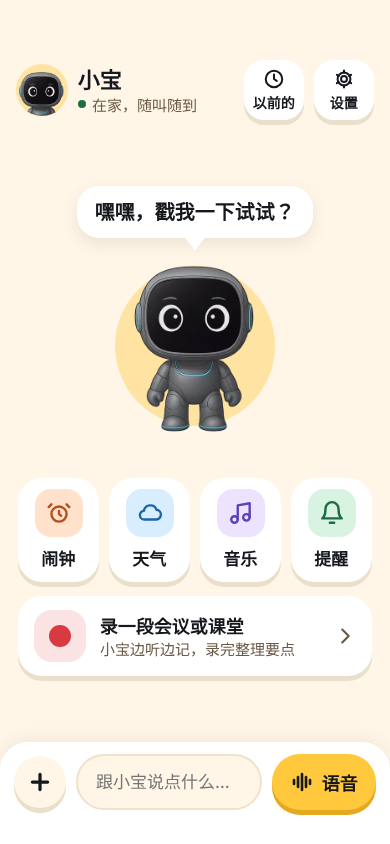
The AI Hub iOS client home screen. The phone is the way in. The core model and the personal data stay on the small computer at home.
Cloud AI is already good. Why build my own?
I use cloud AI tools every day too. They work well. The models are capable, and they save me a lot of setup and upkeep. I am not trying to prove that local AI is smarter than cloud AI.
What actually makes me want to do this is a few other problems.
First, the data. Chat logs might be fine. But if I later want an AI to look through my personal files, sort meeting recordings, search photos, remember my habits, or even control devices in the house, I would rather keep that data, and those abilities, in my own hands. They should not stop being usable because I switch providers, a subscription runs out, or some online service changes its rules.
Second, the token bill. One call to a cloud model may not cost much. If an AI is called dozens of times a day, or hundreds, or keeps working in the background, the cost slowly becomes something I have to think about. I want to see whether everyday use can stop depending on a paid large-model API. The model runs locally. Chat, recognition, judgment, and handing work to tools do not produce a cloud-model token bill.
Of course, zero token fees is not the same as zero cost. The machine still has to be bought. It uses electricity. I have to maintain the software myself. I just hope a fairly predictable cost for the equipment can buy me the freedom to keep using it for a long time.
Last, and the part I think matters most: it has to actually be useful. If it is only an offline chat bot, the novelty may last a few days, and then I will stop opening it.
What do I want it to help with?
What I am asking for is not that grand.
In the morning, ask what the weather is like today, and hear the news while I am at it. When something occurs to me, have it set a reminder. In the evening, when I get home, use my voice to control a light or some other device. At work, ask “where did I put that document last time,” or “what did that meeting from a few days ago actually say,” instead of digging through a pile of folders myself.
Sometimes I take a photo, send a clip of video, or drop in a file, and I hope it can understand what is there, and that I can find it again later. In a meeting I just record. When it is over, turn the audio into text and tidy up the notes. When I think of a new use later, I add a tool. I do not rebuild the whole system.
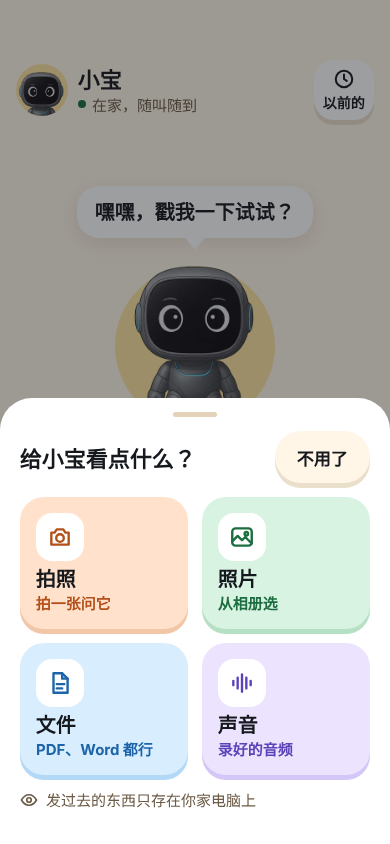
Sending an attachment. You can pick a camera shot, a photo from the album, a file, or a sound, and send it to Xiaobao. The line at the bottom says that what you send stays only on your own computer.
Looked at one by one, plenty of software could already do these things. The problem is that they sit in different apps, different accounts, and different services. What I want is one assistant that connects them, and keeps as much of the work as possible on my own machine.
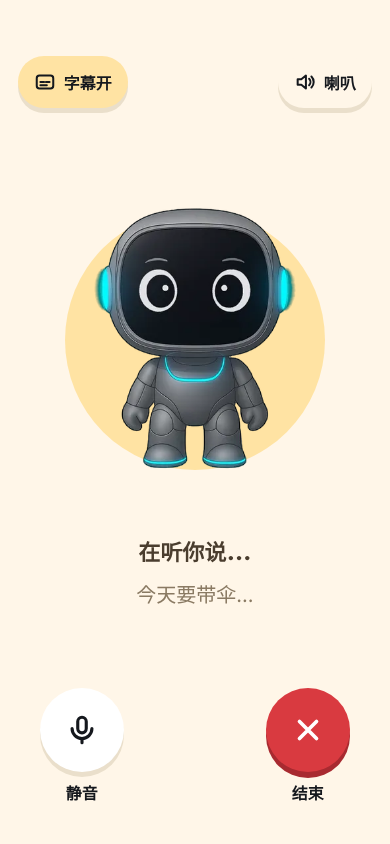
Talking with Xiaobao by voice.
One thing I should say plainly: local AI is not the same as fully offline. Checking the weather, or reading the news, still means reaching an outside source of information. My aim is to keep the model’s inference, the storage of personal data, and the handling of private content on the local machine. When it does need the network, it should only request the public information that task actually needs, not hand the whole private conversation and the files over to a cloud model.
Once I actually started, the trouble was outside the model
AI Hub is not a one-off demo built from nothing. I have already been working on local speech recognition, speech synthesis, conversation, tool calls, and handling recordings. I am also trying to connect a phone, a web page, and an ESP32 voice device to the same computer.
Lately a lot of the time has gone into things that do not look very “AI.” How the phone finds this computer. How a scan connects it safely. How the app, after a reinstall, gets the old chats and recordings back. And how a file or a photo sent during a chat can actually be found again later.
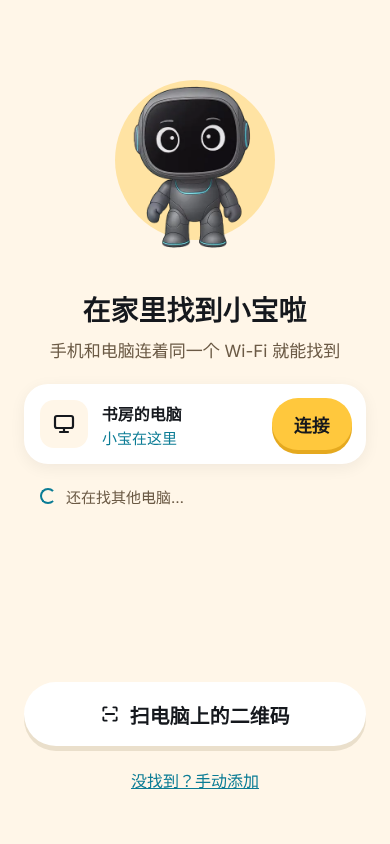
The phone finding and connecting to the local AI computer.
One detail is more interesting than it first looks. Say I send a photo of the bedroom lamp, and at the time I call it “the bedroom lamp.” Image recognition may only come back with something like “ceiling light.” A few days later, when I go looking for “that bedroom-lamp photo,” a search on the picture’s description alone may miss it. So lately I have also been working on tying a photo to what was said in the chat at the time. For someone using it, this is just “help me find that photo from before.” For me, building it, there is a whole string of problems behind that sentence.
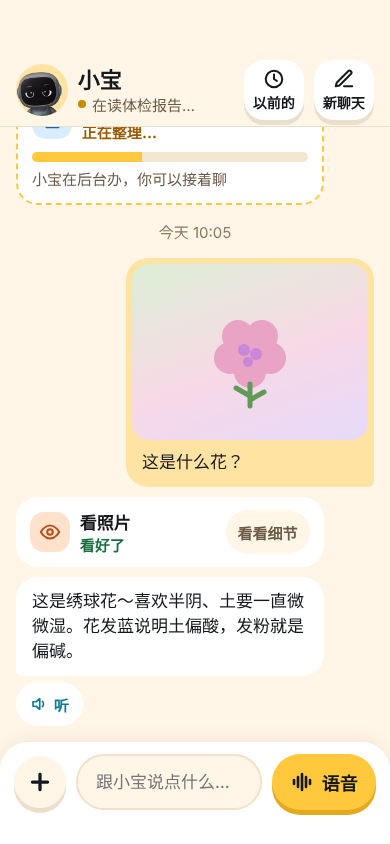
Recognizing a flower: in the chat, ask what flower this is.
Another trouble is getting the AI to use tools correctly. Asking about the weather, looking up a file, and controlling a device can all sound like an ordinary sentence, but they are not handled the same way. I have already run into ordinary chat being misread as a tool call, and the previous turn affecting the next judgment. So I am also building a separate small module, Rex. It is supposed to judge the intent, pull out the arguments, and then decide whether to call a tool. It is being wired in and tested bit by bit. Connecting it is not the end of the work.
More important than that: the AI cannot only know how to act. It also has to know when it should not. A weather check can just go ahead. Anything like unlocking a door, or deleting a file, should get an extra confirmation, even if the recognition looks perfectly sure.
I used to think the biggest barrier to local AI was that the model was too big and the machine could not run it. The more I build, the more I think this: getting a small model to finish ordinary tasks reliably often matters more than simply making it better at answering questions.
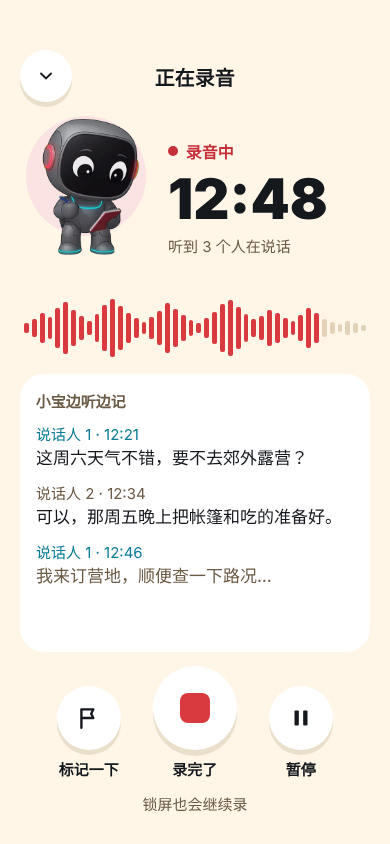
A recording in progress, with what each speaker said written out as it goes.
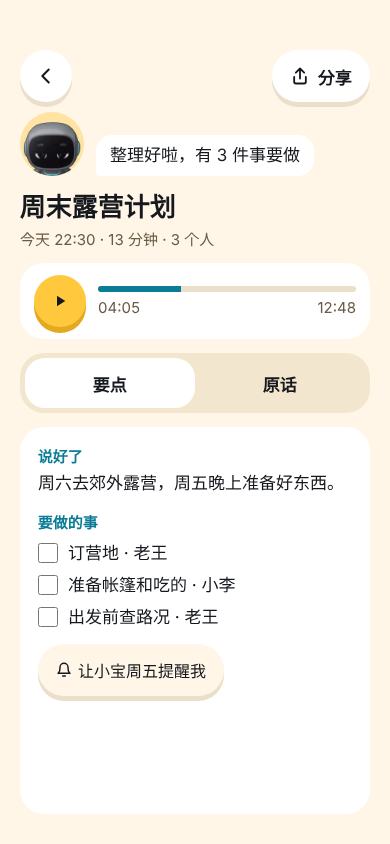
After a recording, the summary and the to-dos.
Is a small model actually enough?
Lately the experiments have mostly been around small models at about the 4B size, and local speech models. Next to a large cloud model, their range of knowledge and their ability at complicated reasoning are of course weaker. Everyday use does not need deep reasoning for every little thing, though.
“Check today’s weather for me.” The model does not need to know, by itself, whether it will rain. It only needs to understand what I mean, find the right weather tool, and say the result clearly. “Find last week’s recording” does not need the model to keep every recording in its head. It should go look in the local files and the index.
So I lean more and more toward splitting the two jobs. The model handles understanding and conversation. The concrete abilities go to tools. Speech recognition, file search, understanding pictures, calendars, and controlling devices in the house can each be a separate ability, put together when needed.
This route may not let it answer every question. It might make it more useful for the things I actually do each day. The cost is dealing with how the models hand work to one another, how fast they respond, how much of the machine they use, and whether the tool calls are right. Those still have to be measured in practice. A feature list is not enough.
Why a dedicated small machine?
Someone might ask: if this is local AI, why not just install it on the Mac, or on the computer I already use?
That works, and while I am developing and testing I often do exactly that. If I want it to become an everyday service, though, a small computer of its own still makes sense. It can stay on. It does not depend on whether my laptop lid is shut. The model and the data sit in one place, and the phone, the computer, and the voice device can all connect. When I add a new way in later, I do not have to deploy the model all over again.
It is a bit like a NAS of my own, except it should do more than store things. Besides keeping files, it should be able to understand them, take instructions, and call tools, and slowly become a basic service at home or in the office.
A dedicated machine brings new problems of its own: whether the performance is enough, whether it slows down when several terminals use it at once, what happens if the power goes out or the network fails, how permissions are managed, and how the data is backed up. All of that is much more trouble than a chat window I can demo, and all of it is still ahead of me.
Still tinkering. A way to go before it is “good to use.”
Some of the basic path is already running. Getting on from the phone, chat and recording, finding files and photos, and routing tools are all still being adjusted. The set of everyday abilities I want is not finished. It is nowhere near something you can take out of a box and use.
I also do not think everyone needs to buy a local AI computer. For someone who asks a few questions now and then, or writes a bit of copy, cloud AI may always be the simpler choice.
But if a person wants an AI around for their work and their life over a long time, needs it to touch a lot of private data, uses all sorts of tools often, and does not want every call to go through a cloud model, then I think this kind of small machine is worth a try.
What I want to make is not that complicated: a small AI computer that sits near me, keeps the data in my own hands, adds no model-token bill to ordinary use, and can gain abilities slowly.
It is not mature yet. Next I will keep a record of which parts actually work, which parts are still awkward to use, and how far one small machine can take local AI.
For me, that is more interesting than making another demo that can chat.
Subscribe · EMAIL
Get the next essay by email
One original essay a week. Send a short note and you’ll be on the list — or follow the RSS feed if you’d rather not use email.
ONE ESSAY